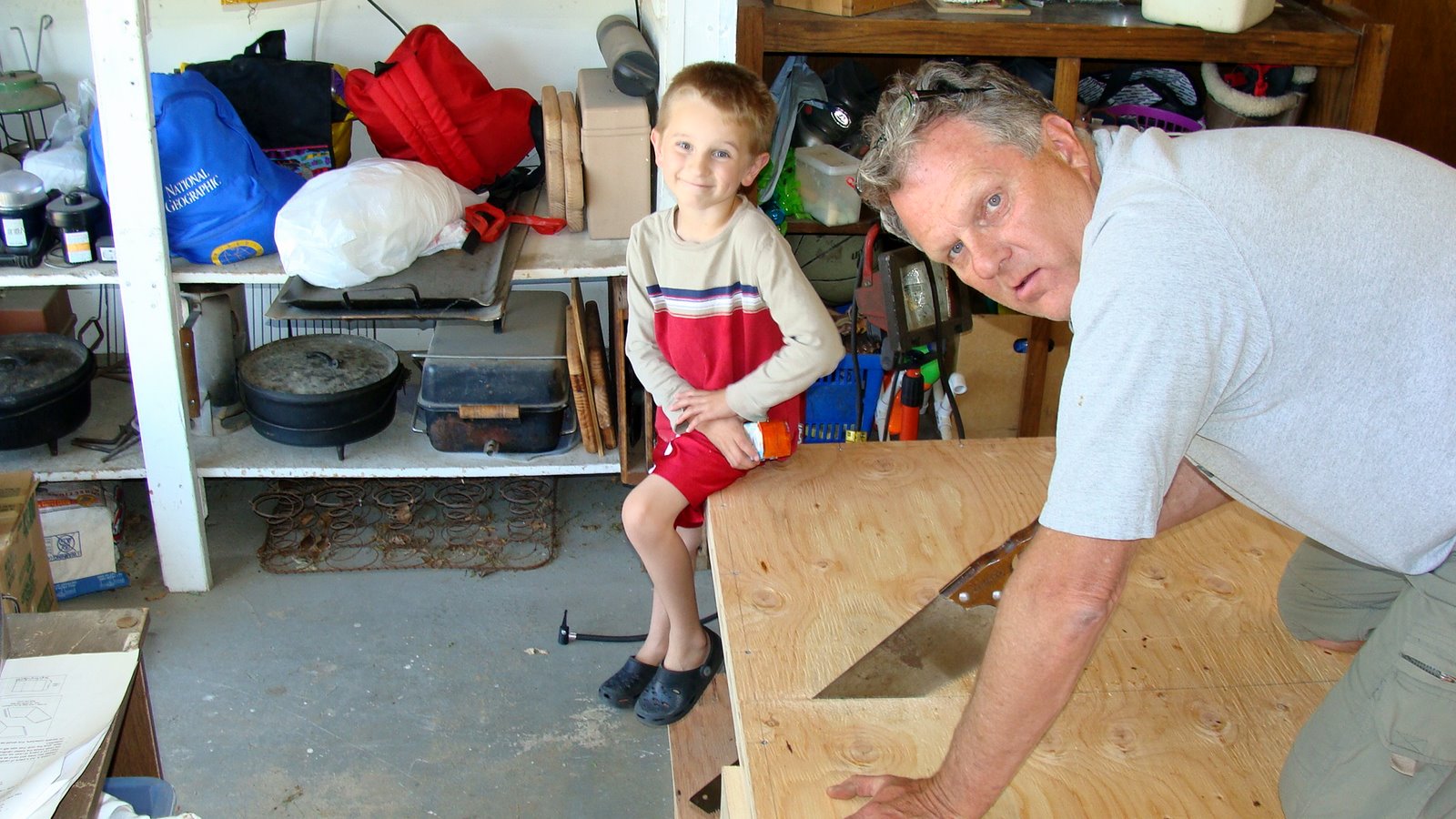

Here I am cutting the front doors

Some of the helpers relax by showing off in front of the camera.

After the doors were cut, it is time to install the hardware. These bolts go all the way through the frame to secure the doors.

 After the hard ware is installed you can see the precision of how the door meets the box, perfect


 Here I am at Aspen Grove Trail Head. For this week end I was TERT, (Timpanogos Emergency Response Team)


 Here we enjoyed the view. Yet we stopped when we started hiking in the snow and mud.
 Christopher enjoying the game of Lacrosse. He cannot wait until he can play catch with his Uncles Paul and John. Give me a ball he says. I want to chew and slobber on it, and play catch.
Our Father in Heaven: This is indeed a bitter moment! We loved our father and Thou hast taken him. But Thou gives and Thou taketh away, and blessed is Thy name. Since Thou hast taken him and the strength of his faith is removed from us, wilt Thou open the windows of Heaven and pour us out a blessing of faith in Thee and in Thy Eternal purposes? Make us equal to what Thou has given. We stand up now Lord to accept that which Thou has given.
Departed Liverpool July 11, 1907 & arrived Quebec July 20, 1907.
They are "Barnardo" children going to Toronto, Ont.
film # T491. see also c4716 and T527.
This list is courtesy of Ken Gibbs. His father is Cecil Gibbs.
ATKINS, James B. 9 ANGELL, Reginald G. 15 ASHTON, Mary 40 AUSTIN, Charles Wm. A. 7 AYERS, Edith 11 BAMFORD, George 8 BANKS, Edmund 11 ARRETT, Geo. Wm. T. 9 BATTISON, Frederick W. 10 BAYLEY Phyllis 17 BELL, Hilda 9 BLAKE, Edward 14 BOWEN, Arthur V. 8 BOWEN, Rolfe Wm. 10 BRENNAN, Annie 11 BRENNAN, Jane 44 BRENNAN, John 9 BRENNAN, Wm. 14 BRETT, Ellen 11 BROWN, Agnes 14 BROWN, Arther 11 BROWN, Joseph 9 BROWN, Thomas 12 BROWN, Winifred 9 BUCKLE, Dorothy 7 BULMER, John 10 BULMER, William 11 BURR, Robina 11 CAREY, Maggie 10 CARRINGTON, Arthur 8 CHANDLER, Nellie 11 CLANCY Florence 10 CLARINGBOLD, Albert 11 CLARINGBOLD, Harold 7 COKER, Alfred Bruce 15 COLE, Winnie 11 COLEMAN, John 16 COOPER, Esther 11 COPE, Ernest 10 COUZENS, John Wm. 13 CRABTREE, Bertha 12 CROSSE, John 16 CROW, Jane 13 CROWDRY, Alfred 10 CURTIS, Flossie 8 DAVIS, George F. 11 DAVIS, Joseph A. 10 DAVIS, Sidney 8 DAVIDSON, Geo. Henry 14 DALY, Cecil 9 DELAFIELD, William A. 13 DOBSON, Ethel Eliza 10 DOUGHTY, Ernest F. 11 DRIFFEL, Florence 10 DUFFIELD, James 11 EAGLE, Charles J. 11 EDWARDS, Thomas A. 10 ELLIS, Mary Margaret 11 EVANS, Frances (f) 11 EVANS, John 19


.
The rapid industrialization during the 19th century in Great Britain created a loss of menial jobs for unskilled workers and high unemployment figures. That and the large scale migration from rural to urban centers caused a population explosion in the poor districts of the major cities of England. Thirty percent of Great Britain was in poverty, one out of four of these paupers was under the age of sixteen. Without a minimum wage men working in the new factories were not being paid nearly enough to support their families. Wives and any children who were old and strong enough also went to work to support their families. Any loss in a family could mean a substantial drop in funds possibly driving the remaining members into destitution. In the 1860s Great Britain suffered an epidemic of cholera, small pox and scarlet fever. The harvests in this decade were particularly bad causing the prices of food to increase dramatically. These were the dire social conditions which fostered the creation of such philanthropic institutions as Dr. Barnardo's Homes for Destitute Children.
In 1850 the Poor Law Act was amended to allow the emigration of destitute and orphaned children despite this few children were actually emigrated to Canada, Australia or New Zealand for another two decades or so. Marie Susan Rye was perhaps the first person to organized the emigration of children. She took about 900 children to Ontario before 1875. Annie Macpherson took about 350. These women were acting as philanthropists who would personally accompany the children to Canada. This soon became impossible when thousands of children were being emigrated. They were criticized extensively for using the emigration as "just a cheap way of getting rid of paupers". Though these women had good intentions without the help of an institution they were not very successful at finding good placements nor adequate supervision for the children once they were in Canada.
Dr. Barnardo was moved by the plight of the destitute children in the slums during the 1860s. So much so that he began his own philanthropic activities in earnest. He was a evangelist who had started one ragged school for boys (there were hundreds at the time). He wrote extensively for evangelistic journals and papers, and was remarkable at getting the middle and upper classes to become aware of plight of the poor. He used what is today considered some very questionable means to accomplish this promotion of his cause.
After a few years he had several homes and schools for children all over the urban centers of England. He quickly ran out of space and people in England willing to adopt the hundreds of children under his care. Emigration to the promising Commonwealth seemed like the answer. He believed that it would be a multifaceted solution to a number of complex problems. Emigration of destitute children would relieve the overcrowded workhouses and industrial schools as well as supply a work force for the farms in Canada, Australia and New Zealand which were struggling to be productive.
Children emigrated from England to Canada came over as third class passengers on ships bound for the ports of Halifax, St. John's, Montreal, Quebec City and Saint John. From there the children would be taken by train to one of the homes located in Knowlton Quebec, Peterborough, Toronto, Hamilton, Brockville, Bellevile, Stratford and Guelph in Ontario or Winnipeg and Russel Manitoba. Most children would stay at one of these home for a few days to a few weeks before they were taken to farms or city homes of people willing to take them in.
Farmers picked out which child they wanted from the arriving shipments of children. Many children were sent over with their sibling and promptly separated from them on arrival. Often they would never see their brothers or sisters for years or sometimes ever again. Unfortunately many of these children were treated no better than slaves by their foster-parents. If a child was ill-behaved they were likely to be sent to another farm. Many were physically, sexually and mentally abused by their foster-parents and were unable to find anyone whom could help them out of their situations.
Though there were a few benefits of the large scale immigration of children to Canada during the late 19th and early 20th centuries it must be view as predominately a sad and unfortunate period in our history. The miss-treatment of thousands of children, though most have long since grown old and passed away, should not be forgotten nor repeated again.
And other places to read about these boys: Link


 and Gary.


